Why Your Website Gets Visitors but Your Contact Form Still Stays Quiet
Your website traffic is up. People are landing on your pages, browsing your services and spending time on the site. On paper, that sounds like progress. For many businesses, it feels like the hard part should already be done. But then you check your inbox, your enquiry log or your CRM and nothing much has changed. The contact form is still quiet.
This is one of the most frustrating situations for any business owner. You know people are finding you. You know your website is being seen. Yet the leads are not coming through in the way you expected. When that happens, the problem is rarely just about traffic. More often, the issue sits somewhere between visitor interest and visitor action.
A website can attract attention without creating enough trust, clarity or urgency to move someone forward. That is where many businesses get stuck. They assume more traffic will solve the problem, when in reality the better solution is often improving what happens after someone arrives.
At iHeartMedia South Africa, this is one of the most common digital challenges we help brands solve. A website should not only look good and bring in visitors. It should also guide the right people towards a meaningful next step.
Traffic does not always mean intent
The first thing to understand is that not all traffic is equal. A visitor is simply someone who landed on your website. That does not automatically mean they are ready to buy, ready to commit or even ready to enquire.
Some people are researching. Some are comparing options. Some are only curious. Others may have clicked through by accident or arrived without a clear understanding of what your business actually offers.
This is why a website can receive steady visits and still generate very few form submissions. If the people arriving are not the right fit, or if your pages are not matching their expectations, they may leave without doing anything at all.
That does not mean your website has failed completely. It means the journey from interest to action is too weak.
Your value may not be clear enough
Many websites make the mistake of assuming the visitor will work things out for themselves. The business owner knows what they offer. The internal team understands the service. But the website copy is often too broad, too vague or too focused on the company instead of the customer.
When a visitor lands on your website, they want fast clarity. They want to know what you do, who you help and why they should trust you. If that message is buried under generic phrases or cluttered design, people may leave before they ever reach your contact form.
A strong website speaks directly to the customer’s need. It removes uncertainty. It makes the value obvious within seconds. If your message is unclear, even interested visitors may hesitate.
Your contact form may be asking for too much
Sometimes the problem is not the website as a whole. It is the form itself.
Businesses often build contact forms that create unnecessary friction. Too many fields, too many questions or too much effort can easily discourage someone from completing the process. If a form feels long, intrusive or time consuming, people are more likely to abandon it.
This is especially true on mobile, where most users want simplicity and speed. A visitor may be willing to enquire, but not if the process feels like work.
The best forms collect only the information needed to start the conversation. You can always gather more detail later. The goal at this stage is not to create admin. It is to make taking the next step feel easy.
Your calls to action may be too weak
One of the simplest reasons a contact form stays quiet is that the website never gives people a compelling reason to use it.
If your call to action simply says Contact Us, that may not be enough. It sounds passive. It does not tell the visitor what they will get, what happens next or why they should act now.
A stronger call to action feels more purposeful. It offers direction and confidence. It reassures the user that reaching out is worthwhile and straightforward.
People do not always take action because they are interested. Often, they take action because the next step feels clear, relevant and low risk.
Trust signals are missing
Even if your service is strong, visitors need proof before they commit. This is one of the biggest gaps on many business websites.
Think about the mindset of a potential customer. They may not know your business personally. They may have found you through search or social media. Before they fill in your contact form, they want reassurance that your company is credible and capable.
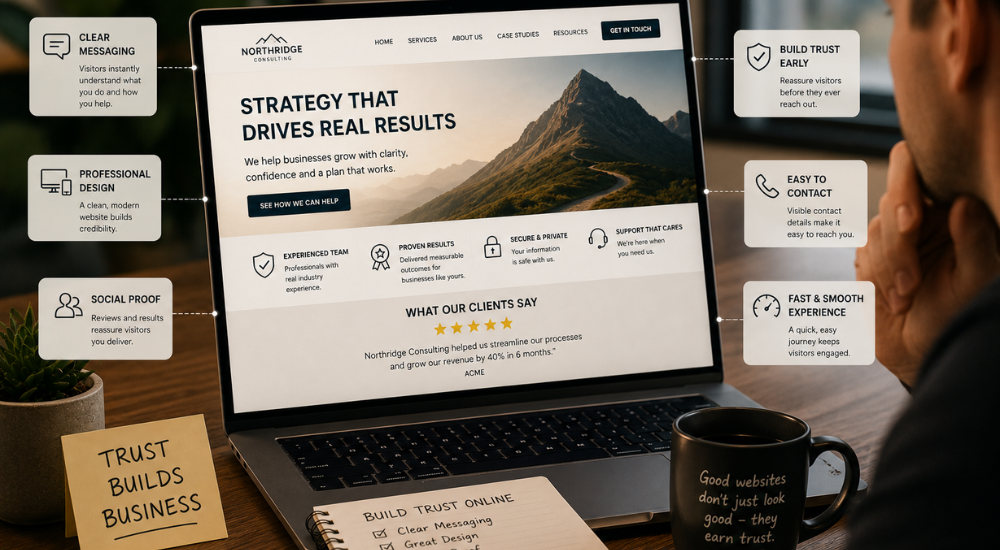
That reassurance comes from trust signals. Testimonials, case studies, client logos, clear service explanations, professional design, recent work and visible contact details all help create confidence. Without these elements, visitors may like what they see but still feel uncertain about reaching out.
Trust is often the missing link between traffic and conversion.
Your website is not guiding the journey properly
A lot of websites are built like online brochures. They present information, but they do not actively guide the visitor through a journey. The user lands on a page, scrolls a little and then has to decide for themselves what to do next.
That approach leaves too much room for hesitation.
A high performing website should gently lead the visitor from one stage to the next. It should answer common questions, address objections, reinforce value and make the path forward feel natural. The contact form should not feel like a separate task at the end. It should feel like the obvious continuation of a good experience.
At iHeartMedia South Africa, we focus on building digital journeys that feel intentional, not accidental. When a website is structured around conversion, it becomes far easier to turn visits into real enquiries.
Speed and mobile experience still matter
It is easy to focus on copy and design, but technical experience still plays a major role. If your site loads slowly, looks awkward on mobile or makes it difficult to tap through pages, visitors will leave before they even consider filling in a form.
South African audiences are especially sensitive to ease and convenience online. A clumsy user experience can quietly damage conversion rates, even if the service itself is excellent.
The smoother the website experience, the more likely visitors are to stay engaged long enough to take action.
If your website gets visitors but your contact form still stays quiet, the answer is not always more traffic. In many cases, the better answer is a better website journey.
You may need stronger messaging, simpler forms, more visible trust signals or clearer calls to action. You may need to reduce friction, improve mobile usability or make the next step feel more inviting. Small changes in these areas can have a major effect on lead generation.
A website should do more than attract people. It should move them. That means giving visitors a reason to trust you, a clear sense of what you offer and an easy way to take the next step.
If your business is getting attention but not enough enquiries, now is the time to fix the gap between visits and conversion. Get in touch with iHeartMedia South Africa to build a website experience that works harder for your business.
Ready to turn website traffic into real opportunities? Speak to iHeartMedia South Africa today and let us help you create a site that generates the leads your business actually needs.